
Jan 17th 2026
Glencal Technology Selected as Finalist for WCSA2025 (ACWA Power Innovation Award)— Zero-OPEX Desalination and Resource Recovery Technology Recognised as a Solution to Global Water and Energy Challenges —
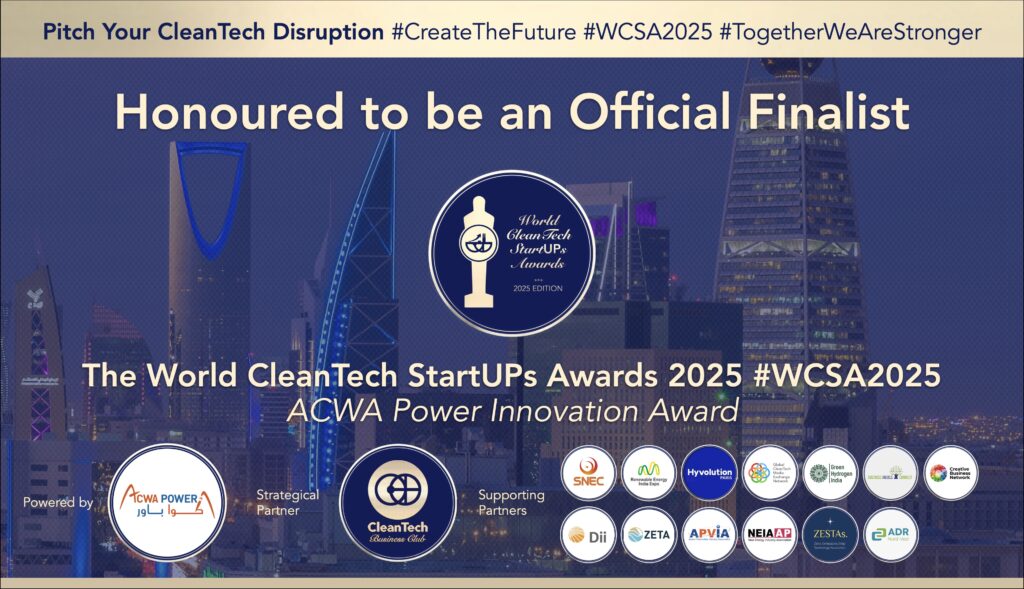
Glencal Technology Co., Ltd. has been selected as a Finalist in the Clean Water & Water–Energy Nexus category of the World CleanTech StartUPs Awards 2025 (WCSA2025).
The Awards are organised by the CleanTech Business Club and supported by ACWA Power, a Saudi Arabia–based global leader in water and energy infrastructure. In 2025, only 12 companies were selected as finalists from applications spanning 25 countries across six continents. The winner will be announced on January 26, 2026, during ACWA Power Innovation Days 2026 (Day 0) in Riyadh.
Glencal’s technology was highly recognised for its approach to zero-OPEX desalination and mineral/resource recovery, enabling the simultaneous optimisation of water and energy infrastructure.
<Focused on Deployment, Not Just Research>
WCSA is not a conventional technology competition. It is an international award program that evaluates innovations based on:
・Their suitability for real-world infrastructure deployment
・Their scalability to large-scale projects
・Their ability to combine economic viability with sustainability
In line with this philosophy, Glencal’s technology is currently being discussed for actual project applications in multiple regions, including Japan and water-stressed, arid regions in the Middle East and beyond.
<Rethinking the Assumption That “Water Must Be Evaporated at 100°C”>
As AI and cloud computing continue to expand, data centre construction is accelerating worldwide, releasing enormous amounts of low-grade waste heat every day. Traditionally, this temperature range of heat has been considered unusable for desalination or drying processes, because industrial water processing has been designed around the assumption that water must be evaporated at high temperature.
<Glencal’s core technology challenges this assumption>
By using plasma to influence electronic states and weaken the hydrogen bonding between water molecules, we make water fundamentally easier to separate and remove—rather than boiling it—enabling low-temperature, ultra-low-energy separation processes, including drying and concentration.
This makes it possible to use low-grade waste heat from data centres as a supplementary heat source to help drive desalination and water treatment, opening a new model of infrastructure integration between digital and water-energy systems.